The 2018 SEO role taxonomy (technical, on-page, content, link builder, analyst, manager) was built for a SERP that no longer exists. AI Overviews, Perplexity, ChatGPT search, and Reddit ate the funnel above it, and the JIRA queue ate the velocity below it. In this post I argue that a head of SEO in 2026 should hire for a builder profile, scored on three axes: ship, write, community. Two of three is the bar. The closing section is a four-line exercise a head of SEO can run on a current team this week.
The 2018 SEO role taxonomy is obsolete in 2026
The technical, on-page, content, link builder, analyst, manager split was drawn for a 10 blue link SERP. That page is now a stack of AI Overviews, People Also Ask, Reddit threads, video carousels, and shopping units, with the classic organic results compressed below the fold. The job description has not followed. Backlinko’s 2026 review of SEO job postings found 96 percent of SEO job descriptions now mention AI, while the role buckets underneath remain the 2018 list with AI Overviews bolted onto one bullet.
I keep coming back to this because the job description sets the candidate filter. A “Technical SEO Specialist” job posting screens for crawl budgets, hreflang, and rendering audits. A “Content SEO” job posting screens for keyword research and brief writing. Neither one screens for the work the 2026 SERP actually rewards. The work is multi-channel and multi-model: Reddit threads, YouTube reviews, Substack newsletters, Glassdoor pages, the brand mentions LLMs absorb during training, and the owned site, all at once. The old roles optimize one surface. The new role optimizes the buyer’s whole research path.
Pull up the current top results for “how to build an SEO team” and the pattern is the same down the page. Every one of them still teaches the 2018 taxonomy with AI bolted on as a skill bullet. Siteimprove’s team-structure guide does name the scaling problem honestly, that single practitioners cannot cover the surface area, but its prescription is more specialists, not different ones. The diagnosis is right. The org chart that follows is the same one from 2018.
AI search ate the SERP the old roles were hired for
AI Overviews, SGE (Search Generative Experience), Perplexity, ChatGPT search, and Claude moved a meaningful share of buyer research off the 10 blue link page. Specialists trained on rank tracking and meta optimization are tuned to a surface that gets fewer clicks every quarter. Kevin Indig and Lily Ray have both been arguing for two years that the click-side of SEO is shrinking faster than the visibility side, and the citation game on the AI side runs on different inputs. Schema, passage retrieval, freshness, and brand mentions in training data carry weight that backlink counts no longer do alone.
Backlinko’s research on AI search behavior puts the average AI query at 13 words against 3 to 4 for traditional Google search. The implication for hiring is direct, in my reading. A 13-word query is a conversation, not a head term, and it is answered by a passage, not a ranked page. I’d take the candidate who can shape passages, write them, mark them up, and ship them, over the candidate who can run a keyword cluster on Ahrefs, every time.
The 2018 role split was built around the head term economy. Volume reports, exact-match optimization, and link velocity all assume a numbered ranking list where progress means climbing from position 8 to position 3. AI Overviews and Perplexity flattened the ladder into a citation set, and the SEO foundations the new team still has to deliver on (indexability, crawl, schema, internal links) became the floor rather than the strategy. Specialists who treated those as their ceiling now sit a layer below where the work happens.
Reddit and forums won as buyer-research surfaces
Buyer research, in my observation, starts on Reddit, Quora, Glassdoor, and YouTube before it touches a Google SERP, and it often never touches a Google SERP at all. The 2026 SEO team needs a person who lives on those surfaces, not a person who reports on them from a Brand24 dashboard. The difference I care about is whether the team can write a credible post in r/SaaS that later gets cited, not whether the team can quote the sentiment score from one.
The pattern is visible in writers who already do this well. Patio11 built Bits about Money inside Hacker News and email, not on a SERP. Lenny Rachitsky built Lenny’s Newsletter inside Substack and his own LinkedIn comments, with paid newsletter growth that does not depend on organic Google traffic. First Round publishes long-form interviews that draw their audience from operator networks, not keyword targeting. SEO teams that show up to those surfaces as outsiders, asking for a backlink, lose every time to people who already post there as participants.
Community presence is also the part of the role that is hardest to fake on a resume. The ship and write axes leave artifacts a hiring manager can pull up in an interview: a GitHub history, a byline, a draft. Community leaves a track record of usernames, posts, and the kind of measured rapport that only registers when the candidate already has it. That is also why it is the axis most often skipped on a job description, and most often missing on the resulting team.
Backlog rot killed SEO velocity inside companies
The largest tax on in-house SEO in 2026, from my years running it inside a SaaS, is not the algorithm. It is the JIRA queue between an SEO recommendation and a shipped change. Routing a schema update or an hreflang patch through a sprint cycle, where it waits its turn behind a feature ticket, is how a company loses citation share before anyone notices.
I watched this pattern repeat inside SaaS marketing orgs of every size. SEO ships an audit. Engineering pulls it into the backlog. The change waits behind a feature release, a refactor, a hiring freeze. Three months later the audit is stale, the SERP has shifted, and the team that did its job on day one is measured on whether the company shipped anything. The honest answer is usually no.
The fix I’d push for is not a better ticket template. The fix is a builder on the SEO team who has commit access and ships the change themselves, the same morning. Schema, meta tags, internal link injections, hreflang patches, sitemap fixes, and most page template adjustments are small surface changes. They earn their way into someone else’s sprint only inside the org charts that wrote the 2018 taxonomy. A 2026 team treats them as SEO-owned surfaces, not eng-owned ones.
Ship-without-asking is the new technical SEO bar
The 2026 technical SEO hire, in my view, deploys schema, internal links, page templates, and log analysis themselves. They open a PR, not a ticket. The job stops being “audit and recommend” and starts being “audit and ship”, which is a different person with a different skillset. Mike King at iPullRank has been making the case for the SEO-engineer profile for years, arguing that SEO professionals need to become content engineers, not specialists with engineering bullet points bolted on. I think the argument was correct when he started making it. I think it is non-negotiable now.
- 01
Schema deploys without an eng review
Product schema, FAQPage where Q&A is visible, Article, Breadcrumb, Organization. The builder writes the JSON-LD and ships it through the same PR template as a copy change, not through a separate structured-data ticket. The AEO answer capsule is a concrete deliverable a builder can ship in a morning. - 02
Internal link graph changes in the codebase
Adding a contextual link from a high-traffic hub to a target spoke is a template edit, not a CMS request. The builder writes the link in the component or the MDX, runs the build locally, and opens the PR. Days, not sprints. - 03
Page template work owned end to end
The 2026 SEO hire can edit the actual template: heading hierarchy, schema scoping, breadcrumb placement, JSON-LD field mapping. They open a PR with the change, they do not file a Linear ticket asking eng to make it. - 04
Log file analysis run by the same person
Pulling server logs, filtering for GPTBot, ClaudeBot, PerplexityBot, and OAI-SearchBot, and writing the brief on what the AI crawlers are missing. Not a request to data eng. Not a Looker dashboard waiting on a ticket. A command line and a notebook.
I think the depth objection lands on the wrong target. Specialization still wins at depth for schema, internal linking, and log analysis, and I’ll concede that openly. The mistake, as I see it, is locating the depth in a separate specialist seat instead of inside the ship axis of a builder. A builder who has shipped hundreds of schema blocks in production is deeper on schema than a specialist who has written the same number of audit slides about schema. The depth lives in the doing.
The builder profile scores on ship, write, and community
My rule is to score every candidate on three axes: ship, write, community. Hire when two are strong. Do not hunt the unicorn who has all three, the search takes too long and the candidate usually exists at someone else’s company. The team carries all three across pairs, not all three inside one person.
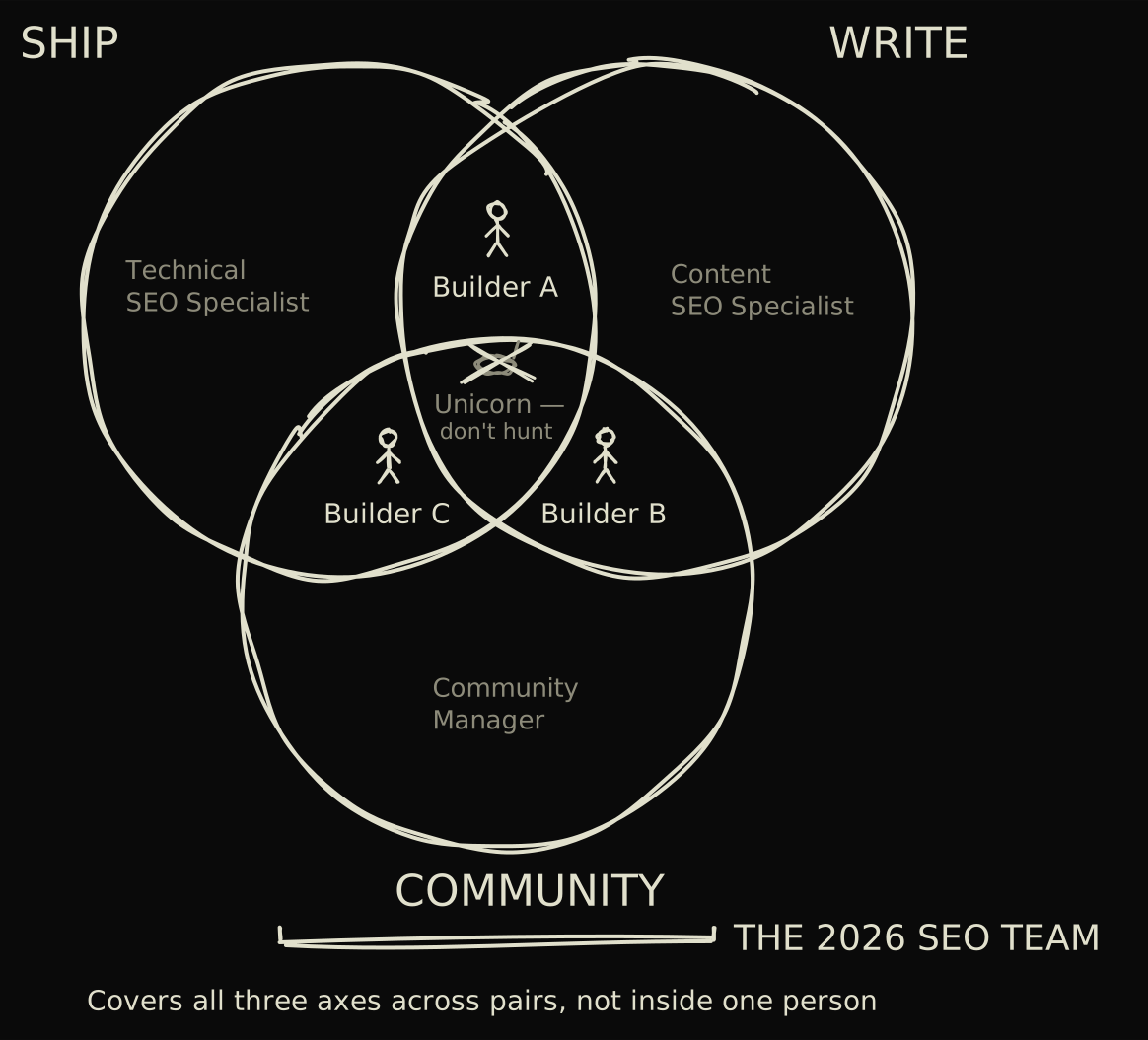
I want to engage the opposing case on its strongest version. A senior schema specialist, given enough runway and a clean codebase, will produce better JSON-LD than a generalist builder. A senior internal-linking specialist will design a better link graph. A senior log analyst will write a sharper crawl-budget brief. Conceding all of that, the question I keep landing on is whether those gains beat the loss from waiting for a specialist to recommend a change a builder would have shipped that week. In the SaaS orgs I’ve worked in or alongside, the answer has been no for a while, and AI search makes the answer more emphatic every quarter.
Pairing solves the depth problem without restoring the old taxonomy. A builder strong on ship and write pairs with a builder strong on write and community. Between them the team covers all three axes, with one axis represented twice. That redundancy is a feature, not waste, because the axes overlap at the edges and the work moves across them daily.
The four-line exercise a head of SEO can run this week
The exercise fits on a single page. For each current team member, score them honestly on ship, write, and community. Then check whether the team, across all members, covers all three axes with redundancy on at least one. StoryChief’s 2026 SEO survey found 53 percent of SEO professionals rank content quality as the top method for improving rankings, and the sharp reading is that content quality is necessary but no longer sufficient. Content that cannot ship without an eng review is a draft, not a deliverable, regardless of how good the draft is.
- 01
Ship: who on the team opened a PR this quarter
Count people, not tickets filed. If the answer is zero, there may still be a builder in waiting on the team, someone with the technical fluency, just without the commit access, tools, or permission the current setup has given them to act like one. If not even that latent builder exists, the next hire is mandatory, not optional. If the answer is one, the team has zero redundancy on the ship axis and the next sick day or resignation drops it to zero. - 02
Write: who on the team published a post under their own name
Bylined on the company blog, on Substack, on LinkedIn long-form, or as a guest on a respected newsletter. Ghostwritten company copy does not count. The signal is whether the team has a writer the market recognizes, not whether the team produces words. - 03
Community: who on the team posts on Reddit, HN, or Substack as themselves
An account history a subreddit trusts, a comment record on HN, replies on Lenny's Newsletter or First Round. Three accounts the team can name beats one Brand24 license the team renews. - 04
Synthesis: does the team cover all three axes with at least one redundancy
If yes, the team is closer to the 2026 profile than most. If no, the next hire's job description writes itself, and the bullets that read 'keyword research' come out before the job posting goes live.
The exercise is not a one-time event. Run it quarterly. Roles drift, people leave, and the AI search surface keeps moving. A team that covered all three axes in May 2026 may have a gap by August because the builder who carried the community axis took a sabbatical. The exercise is cheap to repeat and expensive to skip.
The 2018 SEO role taxonomy was built for a SERP that AI Overviews, Perplexity, ChatGPT search, and Reddit have already replaced. The 2026 hire I’d argue for is a builder, scored on ship, write, and community, with two of three as the bar and the team carrying all three across pairs. Backlog rot, not the algorithm, is the largest tax on in-house velocity, and the fix is a builder with commit access, not a better ticket template. Run the four-line exercise this week. If the team has no one shipping PRs, no one writing under their own name, and no one posting on Reddit as themselves, the next hire is the answer, and the bullets that read “keyword research” come out of the job description before it goes live.