The brief decides most of the article before anyone writes a word
A content brief is the document the writer opens before writing the first sentence, and a useful one commits to four things on a single page: the target query, the searcher’s job, the unique angle, and the specific URL the new page is built to outrank. When all four are named, the draft becomes execution. When any one is missing, the writer is doing keyword research and angle hunting at the same time as wording, and the post that lands is usually a polished version of whatever was already on page one.
The four-part brief is short by design. Backlinko’s analysis of 11.8 million Google results put the average first-page article at 1,447 words, which is a ceiling for the brief’s length, not the draft’s, so the brief itself should fit on one screen. The shorter it is, the more pressure there is to commit to an angle instead of listing topics. An angle is the one-sentence claim the post will defend. For a piece on “best running shoes for flat feet”, the angle is not “we cover the top ten models”, it is “stability features matter less than mid-foot fit, and three of the popular picks fail on the second point”, a position the writer commits to before drafting and the reader can disagree with on the page.
- 01
Target query
The exact phrasing a real person types into Google, picked in the keyword research step. One primary query per page. Variants are useful for headings, not for retargeting. - 02
Searcher's job
The specific outcome the reader came to the page for. Not a category label, the actual task: write the brief, fix the canonical, compare the two tools, decide whether to migrate. - 03
Information gain claim
The single sentence that says what this page contains that the current top three results do not. A dataset, a framework, a case study, a synthesis. No gain claim, no page. - 04
Target URL to beat
The one ranking URL you are designing this draft to replace. Read it carefully. The brief commits to one specific way the new draft will be better, not five vague ones.
The brief sits downstream of the keyword research step that picks the query, and upstream of every other content decision. Without it, intent gets guessed, gain gets skipped, and the draft becomes another parity rewrite. With it, the rest of this chapter is a sequence of execution moves.
The brief also doubles as the rejection criterion for the draft. A draft that ships without satisfying all four lines goes back, regardless of how clean the prose reads. Treating the brief as a hard gate is what stops the calendar from filling with adequate posts that never earn their position.
Intent is a constraint, not a category label
Search intent is the specific job the searcher wants the page to do, and labeling it “informational” or “commercial” describes the shelf, not the job. The category label tells a writer almost nothing useful. The job tells the writer what format, what depth, and what supporting evidence the page has to deliver before the SERP will consider it.
Treating intent as a constraint forces three concrete decisions before the draft begins: the dominant format the SERP rewards, the level of depth the reader expects, and the proof the page has to carry. Google’s own guidance on helpful content names the same idea from the other direction, asking whether the page satisfies the reason a person searched. The label cannot answer that question. The job can.
The constraint version is harder to fake. The category version produces a page that reads like every other page on the SERP, the constraint version produces a page that does the job, which is the only version a model has reason to cite. The cheapest way to read intent honestly is to read the SERP for the query, look at what format actually ranks, and treat that format as a hard constraint, not a suggestion. Tools like Ahrefs and Semrush also surface an intent label on every keyword in their databases, which is useful as a sanity check, but the SERP itself is the authoritative signal because it is the surface a draft has to outrank Search intent is the underlying goal a searcher is trying to satisfy with a query. Google groups it into four broad buckets, informational, navigational, commercial, transactional, but the useful version names the specific job, not the bucket. .
Mixed-intent SERPs are the exception that proves the rule. When the top ten results split between two formats, Google is telling you the query covers two jobs, and one page cannot serve both. The decision is which job your page commits to, not how to cover the union. A page that hedges across both jobs underperforms two pages that each commit to one.
Information gain is the only honest reason a new page deserves to exist
Information gain is the measurable difference between what your page offers and what the top results already cover, and if the gain is zero, the page has no reason to outrank them. Google’s patent on contextual estimation of link information gain describes the model directly, and the field has settled on the same vocabulary, a new page earns its position by adding something the existing set does not have.
The gain can take four shapes: a new dataset the others lack, a new framework that organizes the topic differently, a new case that makes the abstract concrete, or a new synthesis that connects existing parts in a way no single page has. Ahrefs’ study of content updates found that pages winning back lost rankings did so by changing the substance, not the surface. A longer rewrite of the same points is the copycat trap, and it loses every time, because the algorithm prefers the original.
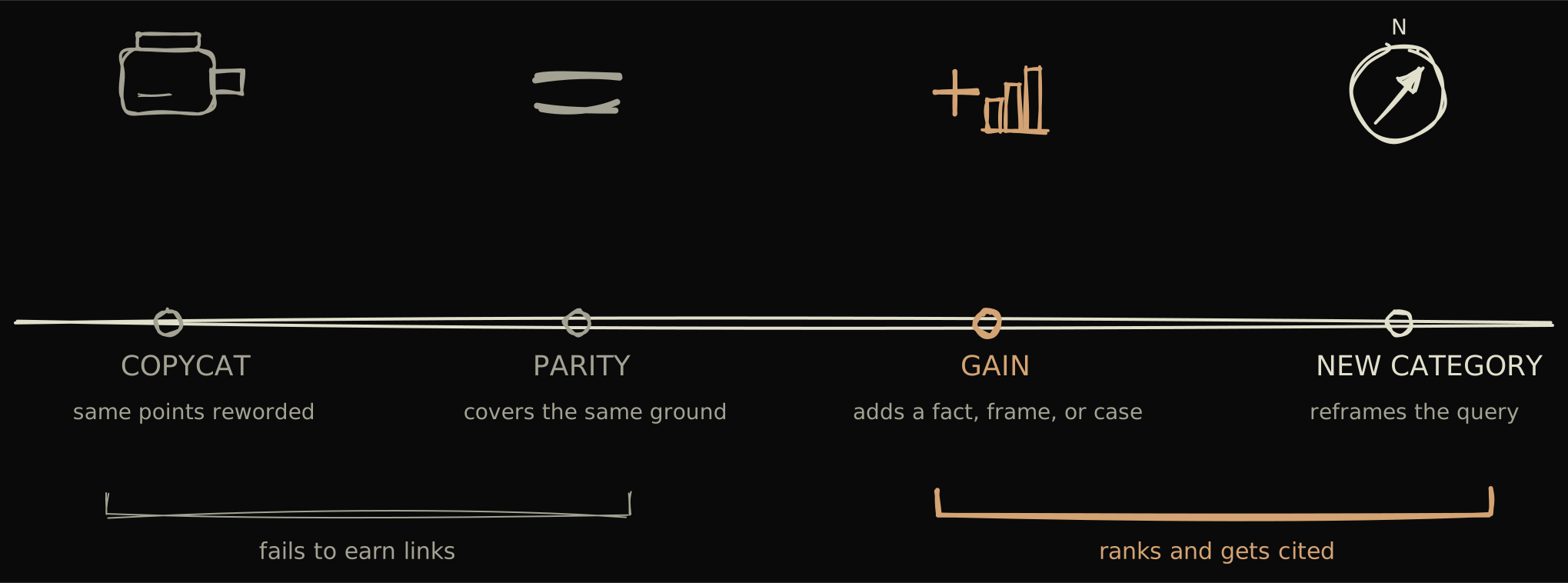
Information gain is the brief’s third line for a reason Information gain refers to the new, non-redundant value a page adds to a corpus on a topic. In ranking research it is treated as the marginal contribution of one document relative to the documents already serving the query. . If the gain claim cannot be written in one sentence, the angle has not been found yet, and the page is not ready to be written.
The same logic applies to AI citation. A model synthesizing an answer pulls passages that add to the synthesis, not passages that restate what other sources already contributed. A parity page is invisible to the synthesis layer for the same reason it is invisible to the ranker, the marginal value is zero, and there is no slot for it.
E-E-A-T is evidence on the page, not a checklist in the CMS
E-E-A-T stands for Experience, Expertise, Authoritativeness, and Trust, and Google’s quality rater guidelines treat it as the four-axis frame raters use to evaluate page quality. The misread is that E-E-A-T is a schema problem solved by filling in Author and Publisher fields. The actual signal is on the page, in the words a reader sees.
Four evidence patterns carry most of the weight. They cost more than schema fields, which is why they work.
- 01
Named author with a verifiable bio
Real name, real role, real credentials linked to a public profile. A linked LinkedIn or company page outranks a faceless byline every time, because the rater and the model can both follow the link. - 02
Dated first-hand observation
A sentence that says what you saw, when, under what conditions. Not a guess about the industry, not a generalization, an observation tied to a date. If the observation did not happen, do not write it. - 03
Sources cited where the claim lives
Inline links on the sentence that makes the claim, with descriptive anchor text. Not a bibliography at the bottom of the page. The model reads the link as part of the sentence and counts it as evidence. - 04
Visible publish and update dates, technically distinct in code
Two dates, both honest, and rendered as separate fields. The page exposes datePublished and dateModified as distinct values in the visible byline and in the article schema markup, not as one combined string. The dateModified field carries more weight than datePublished, because it tells the model how fresh the content is, not just how old the URL is. A stale page with an honest 2024 modified date is more trustworthy than a stale page with a faked 2026 one, because the next refresh will still ship under a credible byline.
The trust signals introduced in chapter 2 cover the schema and HTTPS baseline that every page needs. This chapter takes the same idea a step further and shows that on YMYL topics in particular, the schema-only approach fails on first contact with a quality rater or a citing model, because the evidence has to live in the words a reader can see, not in the metadata they cannot.
Drafts that read human after model assistance keep three things the model strips out
Model-assisted drafts default to balanced, hedged, structurally identical prose, and the human edit exists to put back the three things the model removes by default. Without the edit, the draft reads like every other model-assisted draft on the SERP, which is the same problem as parity content, in a different shape.
The three losses are predictable. A committed point of view goes first, because models are trained to hedge: the reinforcement step that shapes a model’s output rewards balanced phrasing and penalizes sharp takes, so the default draft splits the difference on every contested claim and ends up arguing nothing. Concrete first-hand specifics go second, because the model has no field experience to draw on. Rhythm goes third, because the model averages sentence length toward the middle of its training distribution.
A model-assisted draft is fine as a starting point. But the page that ships has to look like a person wrote it, because the model that will later cite the page is trained to skip past anything that reads like model output.
The asymmetry matters. The model writing the draft produces prose pitched at the middle of its training distribution, with average sentence length, average vocabulary, average rhythm. The model citing that draft is trained to recognize exactly that middle and skip past it. A draft that survives the second model has to break the pattern the first model produced, which is what the human edit is for, and it is not optional on a page meant to earn citations.
A content cluster ties every supporting page to the one URL that earns the business money
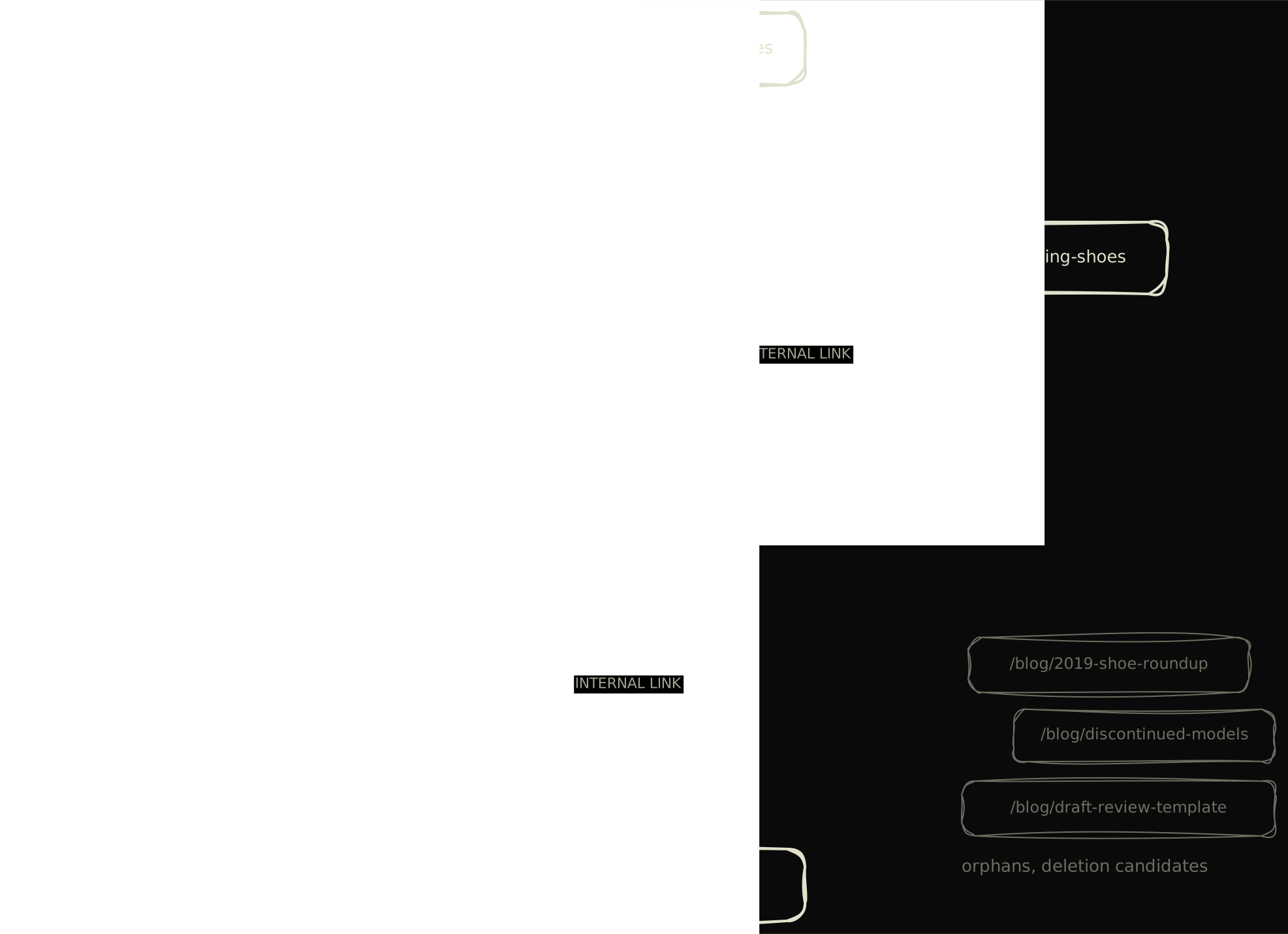
A content cluster is one hub page surrounded by supporting pages that all link inward to it. The hub is the page the cluster exists to rank, and the spokes exist to feed the hub. Pick the URL that earns the business something (the pricing page, the category page, the comparison page, the core product page), then build the supporting pages that route attention, links, and topical signal back to it. Without a hub page, a stack of blog posts is a content pile, not a content strategy.
This is the editorial counterpart to the URL architecture work in chapter 2. That work shaped the routes so a flat topical tree reached every page in two clicks. This work shapes the editorial calendar so every brief, every draft, every published URL has a hub to point at, and the hub has a reason to outrank a competitor’s hub.
The choice of hub decides the cluster, not the other way around. Picking the hub from the keyword list, by which query has the highest volume or the lowest difficulty, is how clusters end up serving traffic but nothing else. Picking the hub from business goals, by which URL closes deals or signs accounts, is how clusters compound into revenue. The keyword research step provides the supporting queries. The business decides which page the queries point at.
- 01
Pick the hub from business goals, not the keyword tool
Start from the URL that converts: the running shoes category page, the pricing page, the integrations comparison. The hub is the page the cluster exists to support, and the support has to be worth the writing budget. - 02
List the queries that ride into the hub
Pull twelve to twenty supporting queries from the keyword research step, each one a question the hub does not answer in depth but the buyer is asking on the way. "how to size running shoes", "running shoes vs trail shoes", "how long running shoes last". Each becomes a candidate spoke. - 03
Audit the existing posts and slot them in
Some of the candidate spokes are already written. Tag those URLs as in-cluster, add the internal link to the hub if it is missing, and remove any orphan link that points outside the cluster. Most clusters start with five or six existing posts already half-doing the job. - 04
Brief the gaps with the hub link in the brief
Every new spoke brief names the hub URL it must link to, with descriptive anchor text, in the body of the draft. The link is a brief requirement, not an editing pass. Spokes that ship without the hub link are not spokes.
The cluster also decides what does not get written. A query that does not feed into a hub does not earn a brief, regardless of search volume. A blog post that fits no cluster is an orphan, and orphans are the largest single category of underperforming content on most sites. Picking the hub first turns the editorial calendar from a wish list into a routing problem with finite answers.
For AI surfaces, the cluster is the structure models can resolve. A model answering a query about running shoes can pull the hub, the sizing post, the comparison post, and the durability post in the same retrieval pass, and the citations land on URLs that share an obvious topical relationship. Scattered posts that do not link inward get retrieved in isolation, if at all, and the citation share collapses to whichever single page happens to score highest on a given query.
Content is a portfolio you maintain, not a stack of posts you ship
A portfolio approach treats every published URL as a position to defend or retire, which is the opposite of the publishing-target mindset that drives most editorial calendars. The publishing-target mindset asks how many posts shipped this month. The portfolio approach asks how many positions held, how many improved, how many got merged, and how many were retired.
The cadence most content teams settle on is the same: monthly review of the top thirty trafficking URLs, quarterly review of the long tail. The cadence is not arbitrary, monthly review fits the rhythm at which most content drift becomes visible in analytics, and quarterly review fits the rate at which deeper cluster work pays off.
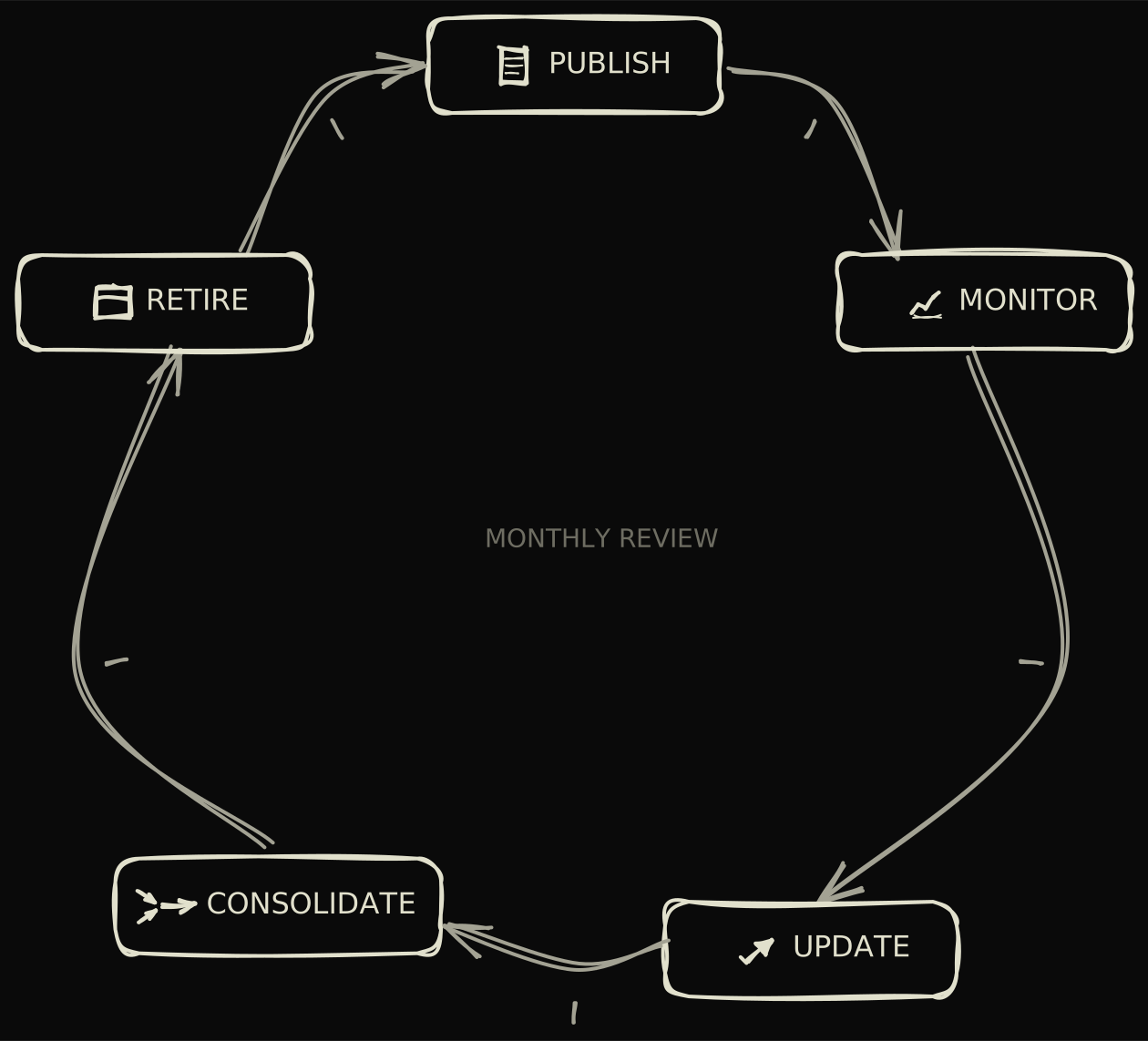
The monthly review is what turns the portfolio approach from a concept into a recurring habit. The aim is to make a decision on every URL in a finite list, push the work to the writing calendar, and close the cycle before the next review starts. Four steps fit the loop.
- 01
Pull the URL list
Top thirty pages by impressions in Search Console for the last 28 days, plus any URL flagged for follow-up at the previous month's review. The list is finite by design, the work fits in a single planning session, and the point is to make a decision per URL, not to scan everything. - 02
Tag every URL with a status
Holding, slipping, dead, or candidate to merge. Four labels, no others. The status decides which of the four actions in the section below the URL gets routed to. - 03
Decide actions for the slipping and dead URLs
Update, rewrite, consolidate, or delete. One action per URL. The decision tree in the section below handles the routing. - 04
Schedule the work into the writing calendar
Portfolio work competes with new posts for the same writer hours. A review that produces zero scheduled work means either the portfolio is perfect or the review was performative.
The portfolio approach is the discipline that separates content teams that compound from content teams that publish. Compounding teams retire as much as they ship.
The pressure to scale content with model-assisted writing makes this discipline more important, not less. Teams that publish ten times faster also accumulate ten times more URLs to defend, and the ones that do not retire on the same curve end up with thousands of pages no one is willing to delete. The cautionary tale of 2024 and 2025 was the wave of programmatically generated AI content that ranked briefly and then got demoted in a single Helpful Content update, taking the host site’s traffic with it. The portfolio approach is the antidote: publish only what you are prepared to maintain, retire what no longer earns its position, and let the cluster carry the topical authority instead of the volume.
The update, rewrite, consolidate, delete decision has a rule, not a vibe
Every underperforming URL gets routed to one of four actions, and the routing follows two yes-no questions in order: is the query still worth ranking for, and is this the right URL to rank. Two questions, four outcomes, no debate.
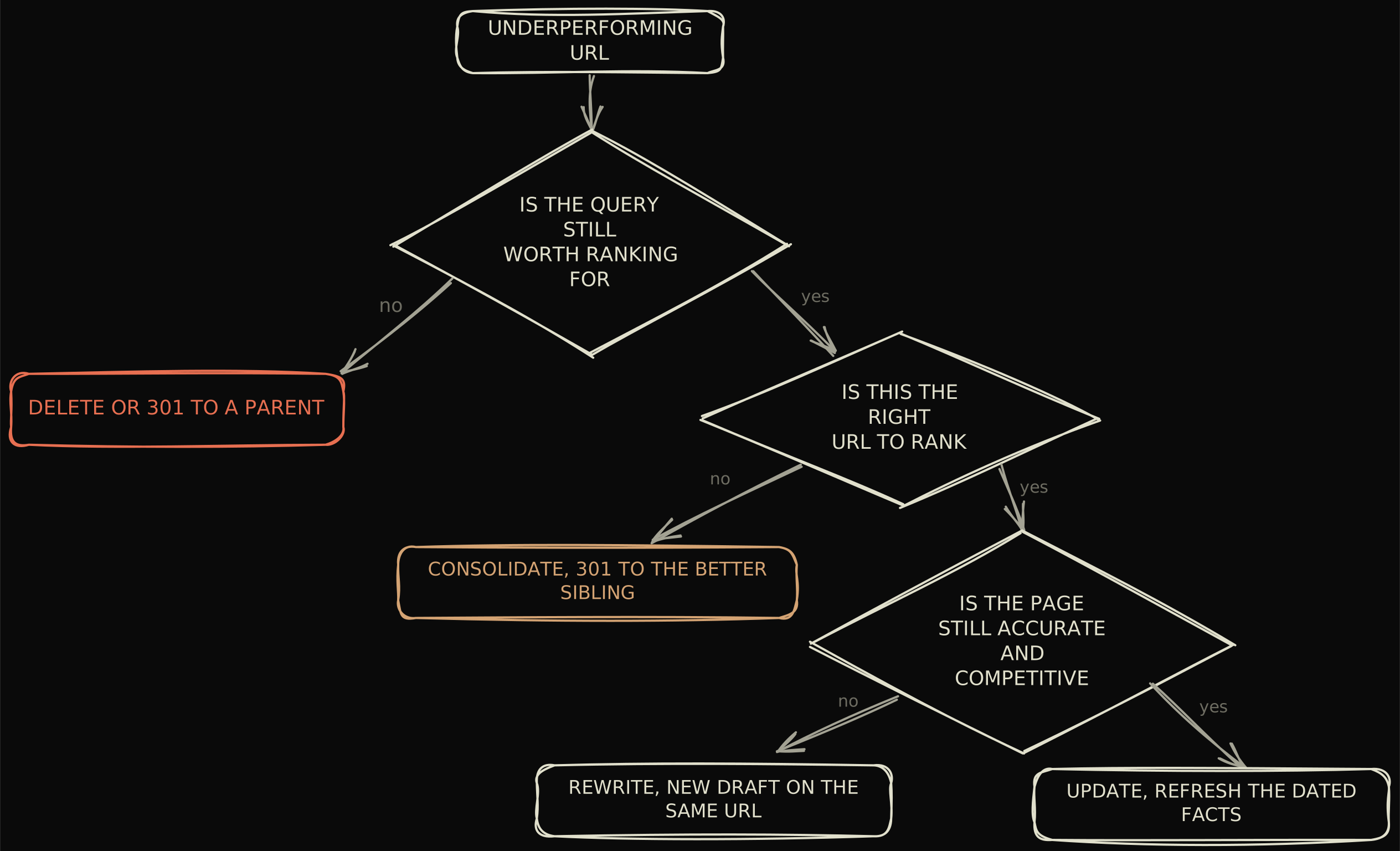
Google’s canonicalization guidance covers the technical half of consolidation, and the technical chapter later in this guide covers the redirect mechanics. The decision tree decides the action, the technical chapter executes it.
Cannibalization is a sibling problem, not a duplicate problem
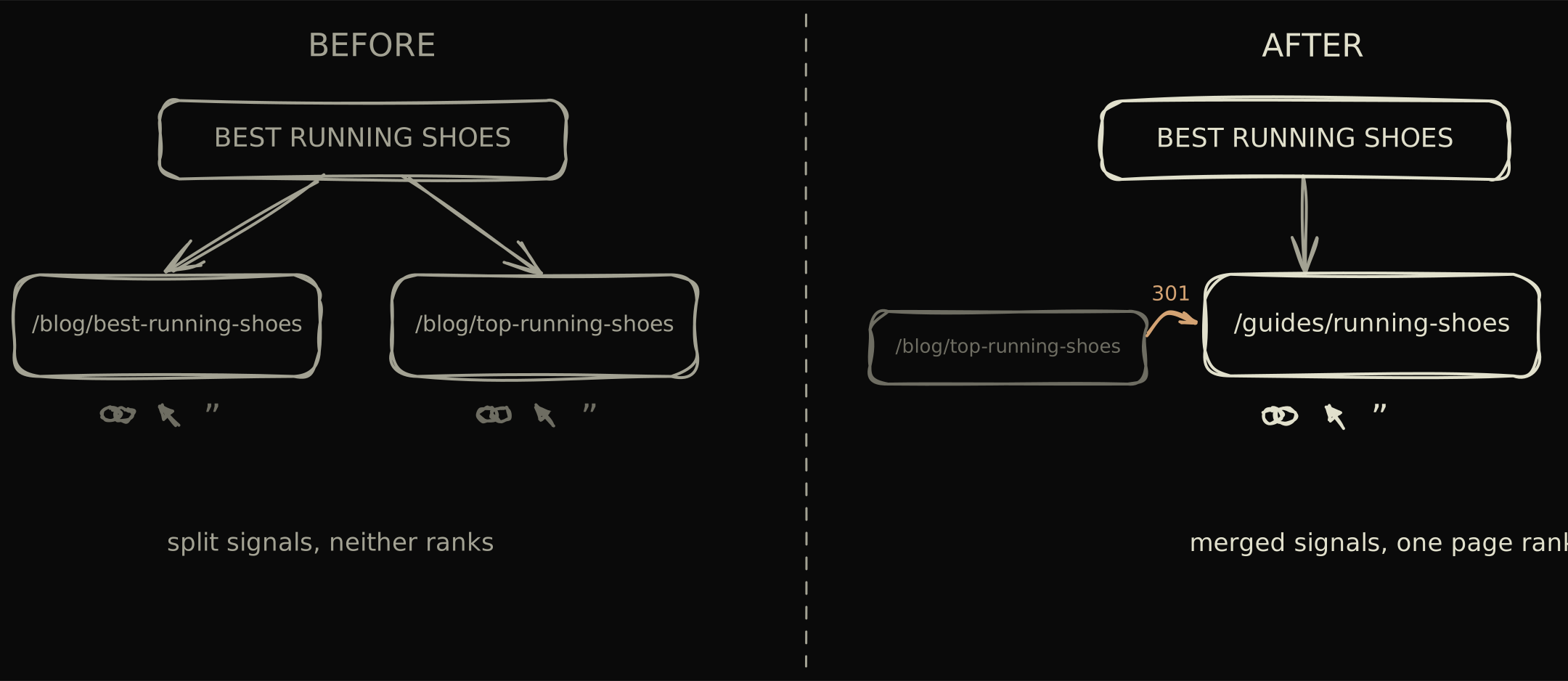
Content cannibalization happens when two of your own URLs target the same intent, and the algorithm splits clicks, links, and model citations between them instead of concentrating the signal on one. It is not a duplicate-content penalty. Google has repeatedly clarified that duplicates are canonicalized, not penalized. The harm is dilution, two half-ranking pages, neither of which crosses the threshold to win.
- 01
Export the query-URL pairs
Pull the last 90 days of Search Console data at the query and URL level. Look for queries where two or more of your URLs each pick up impressions and split the position. - 02
Confirm the intent overlap
Read both URLs. If they are answering the same job for the same searcher, it is a sibling problem. If the jobs differ, the SERP is correctly assigning two queries to two pages. - 03
Pick the survivor
The URL with more backlinks, longer history, and the cleaner slug usually wins. The losing URL gets a 301 to the survivor. - 04
Merge the substance, then redirect
Anything useful in the losing URL gets folded into the survivor before the redirect ships. Once redirected, the merged page accumulates signals from both histories.
A canonical tag handles softer cases, where both pages should remain accessible but only one should rank A canonical tag is an HTML element that tells search engines which URL is the preferred version when several URLs serve similar content. The non-canonical URLs stay accessible to users, but the canonical URL gets the ranking signals. . A 301 handles the harder cases, where the losing URL serves no purpose alive.
Sibling problems also show up in the citation layer, where two of your URLs each pick up a fraction of the citations a single URL would have absorbed. The fix is the same. Models prefer to cite the single authoritative URL on a topic, so consolidating siblings concentrates citation share the same way it concentrates click share, and the merged page becomes the canonical answer for both queries.
AI citability is decided by the first 150 words and the structure of every paragraph after
Models cite passages, not pages, and the pattern of which passages get cited is stable enough in 2026 to design for. A quotable answer capsule near the top of the page picks up the largest share of citations, supporting passages from the middle of the page pick up the next share, and a closing synthesis picks up the rest. The opening is the highest-leverage real estate on the page, and the structure of every paragraph after decides whether the rest of the page contributes anything at all.
The capsule earns the heaviest pull because it is the cheapest passage for a model to lift verbatim. It already answers the query, it fits inside a chat response without rewriting, and it carries a citable specific in the second sentence. Pages that bury the answer under throat-clearing or a long anecdote forfeit this slot, and the model picks up its quote from a competitor instead.
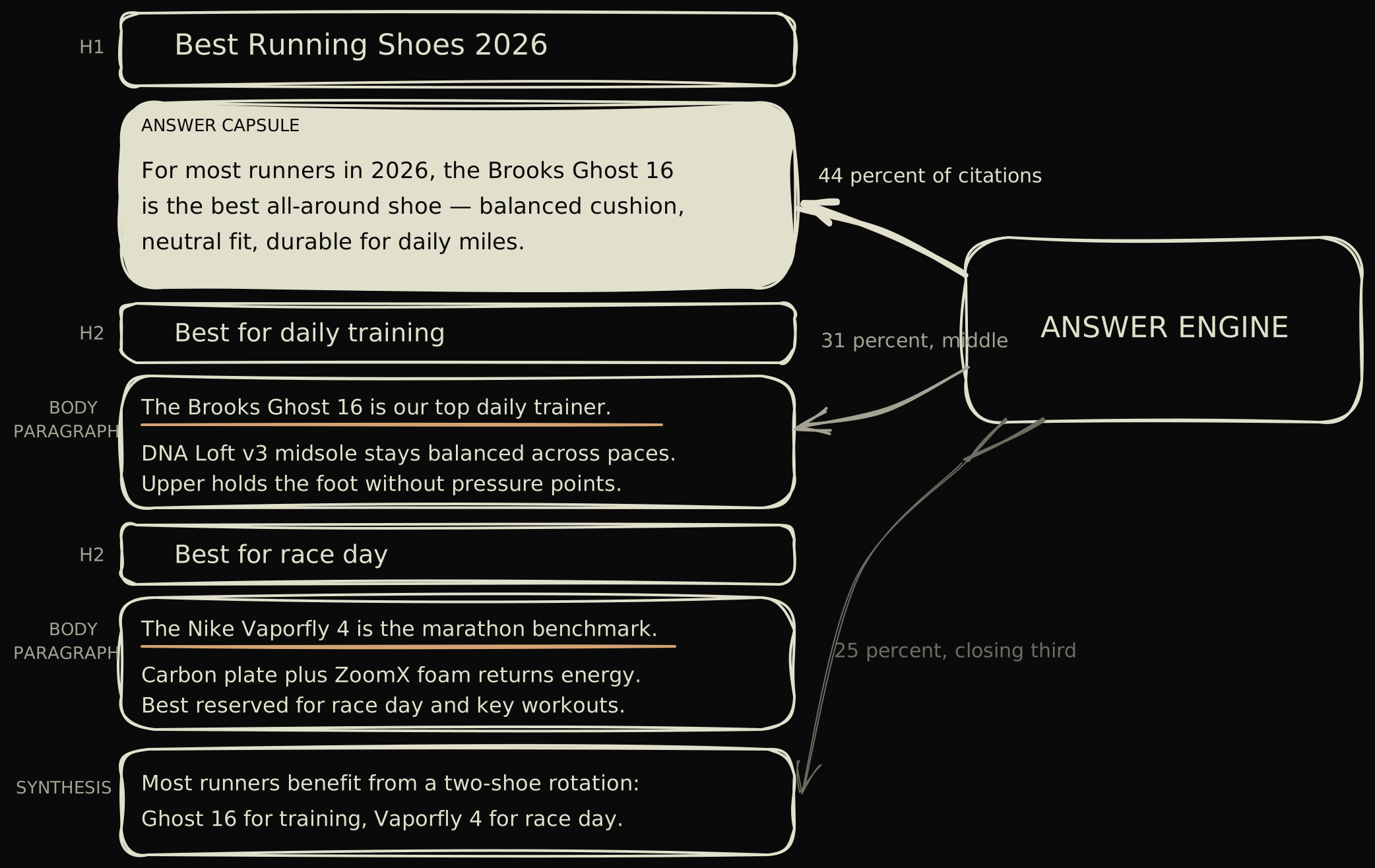
The percentages are observed averages across a sample of cited pages, not a rule the engines publish. Roughly 44 percent of citation pulls land in the first third of the page, 31 percent in the middle, and 25 percent in the closing third. What the ratio tells a writer is structural, not numerical: design for citations at three points on the page, not one, and the closing third still needs facts to cite, not a CTA.
Per-paragraph structure carries the rest. Every paragraph names its subject in the first sentence, packs the densest information into the middle, and ends on the analytical implication. That shape is what makes a paragraph independently quotable, which is what makes the page citable beyond its opening. The synthesis step in AI answer engines explains why this shape works: the answer engine retrieves paragraphs, ranks them by how well they answer the query, and writes a synthesis citing the highest-ranked ones.
Subject sentences also have to stand alone. A paragraph that opens with “this means” or “they argue” forfeits its citation slot, because the retrieval layer cannot resolve the backward pronoun outside the page. Naming the subject in the first sentence costs nothing and makes the paragraph quotable in isolation, which is the only state the model ever sees it in.
A working hypothesis about paragraph length follows from the same retrieval mechanics, though the data on this is thinner than the citation-distribution observation above. A six-sentence paragraph plausibly carries one citation slot, where two three-sentence paragraphs may carry two, because the retrieval unit appears to be the paragraph, not the sentence. The claim is not measured, but the mechanics suggest the cheap move is to split paragraphs along their natural subject boundaries, doubling the citation surface without adding a word.
Frequently asked
-
How long should an SEO content brief be?
A useful brief fits on one screen. The four committed parts, target query, searcher's job, information gain claim, and target URL to beat, are the brief. Anything else is supporting material that belongs in a separate doc. -
How often should I update existing SEO content?
Monthly review of the top thirty trafficking URLs, quarterly review of the long tail. Updates ship only when a URL is slipping and the page still owns the right query. Date bumps without content changes are detected and demoted. -
What counts as information gain?
A new dataset, a new framework, a new case study, or a new synthesis that connects existing parts in a way no top-ranking page does. A longer rewrite of the same points is parity, not gain, and parity does not outrank the original. -
Is cannibalization the same as duplicate content?
No. Duplicate content is two URLs with near-identical text, and Google canonicalizes it, not penalizes it. Cannibalization is two URLs targeting the same intent, and the harm is signal dilution between siblings. The fix is a merge or a canonical, not a rewrite. -
What is YMYL content?
Your Money or Your Life. Pages on health, finance, legal advice, or major life decisions, where inaccurate information could harm the reader. Google's quality system applies a stricter evidence bar to YMYL pages, and the on-page E-E-A-T signals matter more.
SEO content compounds when the portfolio is the unit of work
SEO content is a portfolio job, decided mostly at the brief stage, defended by a recurring review, monthly for the top URLs and quarterly for the long tail, and judged in 2026 by whether a model can quote the page back to a reader. The brief commits to query, job, gain, and target URL. The cluster decides which hub each new brief supports. The draft puts back the opinion, specifics, and rhythm that model assistance strips out. The portfolio review routes every underperforming URL to update, rewrite, consolidate, or delete, with no fourth option for inaction.
The brief is the first contract. The portfolio is the second. Everything else is execution against both.